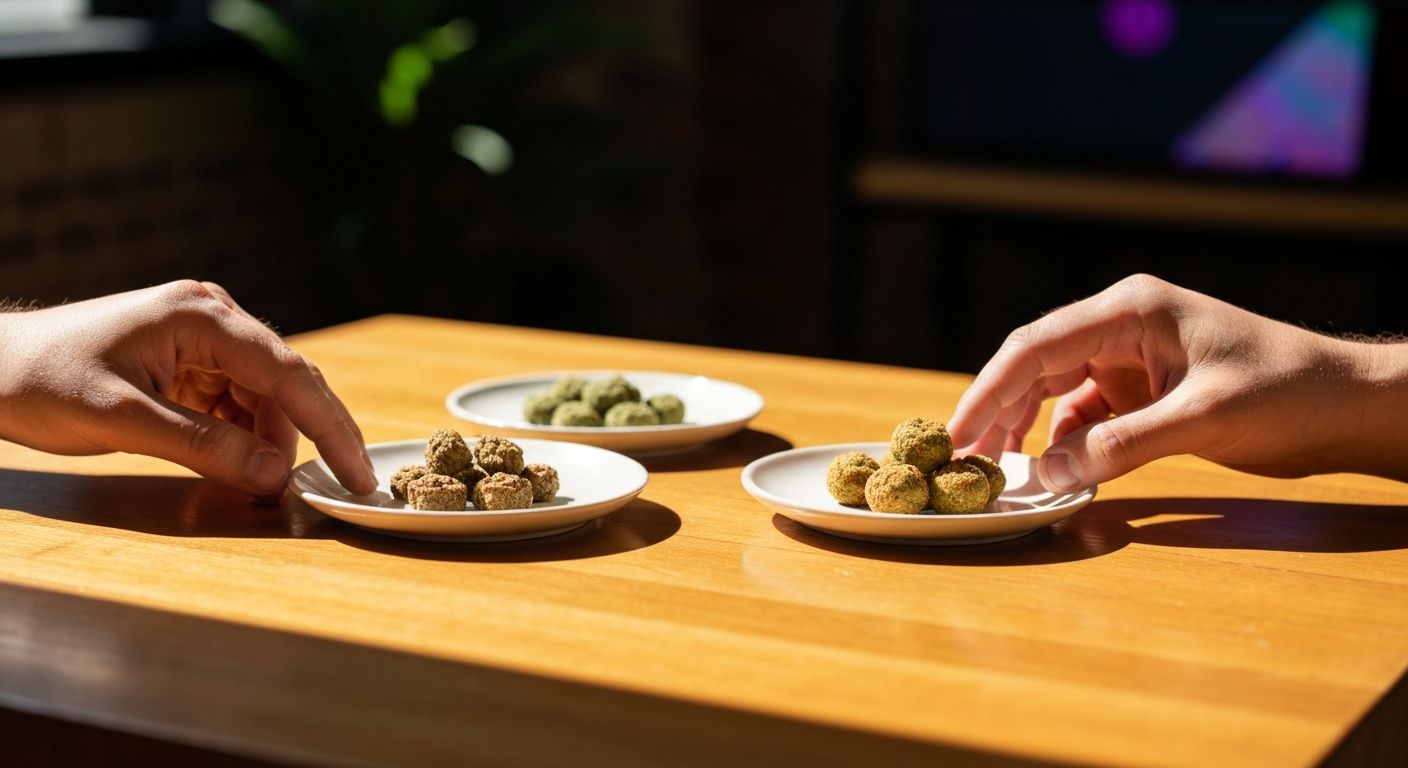
Weed tinctures work better for acute, fast-relief pain because sublingual absorption delivers effects in 15 to 30 minutes with precise dosing control. Edibles work better for sustained, full-body pain relief lasting 4 to 8 hours, though onset takes 45 to 90 minutes. Your best choice depends on whether you need speed or duration.
How Do Tinctures and Edibles Actually Work Differently for Pain?
The fundamental difference between tinctures and edibles comes down to how your body absorbs them, and that distinction matters enormously when pain relief is the goal.
Tinctures are administered sublingually – you place drops under your tongue and hold them there for 30 to 60 seconds. The thin tissue under your tongue is packed with blood vessels, so THC and other cannabinoids pass directly into your bloodstream without making the trip through your digestive system. This means faster onset, more predictable timing, and a cleaner dose-to-effect relationship.
Edibles take a completely different path. When you eat a gummy or any other weed edible, it travels through your stomach and into your liver, where delta-9 THC gets converted into 11-hydroxy-THC. This metabolite is actually more potent than standard THC and produces a more intense, full-body effect. That liver conversion is why edibles hit harder and last longer, but also why they take their time arriving.
For people transitioning from medical programs into recreational purchases, this pharmacological difference is not academic. It is the difference between managing a tension headache during your afternoon and settling into relief for a full evening after a physically demanding day.
According to research published by the National Institutes of Health, sublingual administration of cannabinoids achieves peak blood concentration significantly faster than oral ingestion, which aligns with what thousands of users report anecdotally.
What Types of Pain Respond Better to Tinctures?
Tinctures excel when the pain is localized, sudden, or when you need to function while managing it. Think of the kind of discomfort that interrupts your day rather than defining it.
Tension headaches, jaw pain from clenching, acute muscle tightness after exercise, and stress-related body tension all respond well to tinctures. The fast onset means you are not waiting around wondering if it is working. Within 15 to 30 minutes, you know. And because tincture dosing is measured in precise milligram increments using the dropper, you can dial in exactly the amount that takes the edge off without overwhelming you.
This precision matters for people who previously relied on medical dispensary budtenders to help them calibrate. Recreational tinctures at The Flowery carry the same detailed potency information on their labels, so you are not guessing.
The duration of tincture effects typically runs 2 to 4 hours, which makes them practical for daytime use. Take a dose in the morning, function through your workday, and re-dose if needed in the afternoon. The predictable window gives you control over your schedule.
Discussions on Reddit’s r/NYCtrees frequently highlight tinctures as the preferred method for people managing daily discomfort who cannot afford to be couch-locked at 2 PM.
What Types of Pain Respond Better to Edibles?
Edibles are the heavy lifter. When pain is widespread, chronic, or the kind that keeps you up at night, the longer duration and stronger body effect of edibles make them the better tool.
Joint stiffness, lower back pain, recovery soreness, arthritis-related discomfort, and the kind of full-body ache that settles in after a long day on your feet – these are edible territory. The 11-hydroxy-THC produced during digestion creates a deeper body sensation that many users describe as warmth spreading outward, relaxing muscles and quieting pain signals in a way that feels more complete than other methods.
The 4 to 8 hour duration of edibles is the key advantage for nighttime use. A single dose taken 90 minutes before bed can carry you through the entire night, which matters enormously if pain has been disrupting your sleep.
Wyld and Camino gummies are popular choices for pain management because they offer reliable dosing and strain-specific formulations. Indica-leaning edibles tend to provide the strongest body relief, while balanced hybrids work well for people who want relief without heavy sedation.
The trade-off is patience. Edibles require planning. You eat one, you wait, you do not eat another because the first one has not kicked in yet. That lesson, which many medical patients learned the hard way, remains the most important rule of edible consumption.
How Do Tinctures and Edibles Compare Head to Head?
| Factor | Tinctures | Edibles |
|---|---|---|
| Onset time | 15 – 30 minutes | 45 – 90 minutes |
| Duration | 2 – 4 hours | 4 – 8 hours |
| Dosing precision | Very high – measured drops | Moderate – pre-dosed units |
| Best for pain type | Acute, localized, daytime | Chronic, widespread, nighttime |
| Body effect intensity | Moderate | Strong |
| Taste | Herbal, sometimes bitter | Flavored, easy to consume |
| Calorie content | Zero to minimal | Contains sugar and calories |
| Discretion | Very discreet | Very discreet |
| Learning curve | Low – adjust drops incrementally | Moderate – must wait for onset |
This comparison shows why many experienced users keep both in their rotation. Tinctures handle the quick fixes. Edibles handle the long game. Together, they cover the full spectrum of pain scenarios without ever needing to smoke or vape anything.
Can You Use Both Tinctures and Edibles Together?
Yes, and many people do – but the approach requires intention, not improvisation.
The most common combined approach is called “stacking.” You take a tincture for immediate relief and follow it with a low-dose edible to extend the duration. By the time the tincture is wearing off around the 2 to 3 hour mark, the edible is coming online. The result is a smooth, continuous relief window that can last 6 to 8 hours.
The key to making this work safely is keeping individual doses modest. If your typical tincture dose is 10mg and your typical edible dose is 10mg, you might use 5mg of each when combining. Start conservative and adjust from there over multiple sessions.
According to the New York Office of Cannabis Management, all licensed products in New York must clearly display THC content per serving, making it straightforward to calculate combined doses.
For former medical patients who are accustomed to thinking about their consumption in clinical terms, this stacking approach often feels familiar. It mirrors the way many prescription pain protocols layer a fast-acting medication with an extended-release formulation.
What Should Medical-to-Recreational Buyers Know About Dosing?
The transition from medical to recreational weed purchasing comes with a shift in how products are framed, but the underlying pharmacology does not change. THC is THC. CBD is CBD. Your body processes them the same way regardless of which dispensary sold them to you.
What does change is the guidance structure. Medical dispensaries often assign you to a pharmacist or patient consultant who tracks your usage and adjusts recommendations. Recreational dispensaries put more responsibility on you, which is why understanding the basics of tincture and edible dosing matters.
For tinctures, start with 2.5mg to 5mg if you are new to them. Hold under your tongue for a full minute before swallowing. Wait 30 minutes before considering another dose. Most people find their effective range falls between 5mg and 25mg per dose.
For edibles, start with 5mg. Wait a full 2 hours before taking more. The biggest mistake people make with edibles is impatience, and it predates legalization by decades. The Alcohol and Drug Foundation notes that edible overconsumption is almost always a timing error rather than a dosing error.
The Flowery’s budtenders across all 12 locations can walk you through product-specific dosing guidance. If you are coming from a medical background, tell them. That context helps them match you with the right potency level.
Where Do You Find Quality Tinctures and Edibles in NYC?
The Flowery carries a curated selection of both tinctures and edibles across every location and through citywide delivery. Every product on the shelf comes from licensed producers and carries full lab testing results, which is the baseline standard that former medical patients should expect and demand.
Browse the full menu online before visiting to see current tincture and edible inventory. Pain management products move fast, especially lower-dose options that appeal to newer consumers and precise dosers.
Frequently Asked Questions
Are weed tinctures stronger than edibles for pain?
Tinctures are not stronger per milligram, but they deliver effects faster due to sublingual absorption. Edibles actually produce a more potent metabolite through liver processing. Strength depends on your dosage, not the delivery method. Most pain users find edibles feel more intense at equivalent doses.
How long do pot tinctures take to work for pain relief?
Pot tinctures typically begin working within 15 to 30 minutes when held under the tongue properly. Swallowing the tincture instead delays onset to 45 to 60 minutes, similar to an edible. Hold drops under your tongue for at least 60 seconds for the fastest absorption and most predictable timing.
Can I buy tinctures without a medical card in NYC?
Yes. New York’s recreational weed program allows any adult 21 and over to purchase tinctures, edibles, and all other product categories at licensed dispensaries like The Flowery. No medical card, prescription, or prior medical program enrollment is required.
What is the best edible dose for pain if I am new to pot?
Start with 5mg THC per serving and wait at least 2 hours before considering another dose. Many first-time edible users find that 5mg to 10mg provides noticeable pain relief. Going higher too fast leads to uncomfortable overconsumption that can last several hours.
Do tinctures and edibles show up on drug tests the same way?
Yes. Both tinctures and edibles introduce THC into your system, which metabolizes into the same compounds that standard drug tests detect. The delivery method does not change how THC shows up on testing panels. Detection windows depend on frequency of use, not consumption method.
Are there CBD-only tinctures and edibles for pain at NYC dispensaries?
Licensed NYC dispensaries primarily stock THC-containing products. For CBD-only options, you may find select products at dispensaries, but dedicated CBD shops carry broader selections. THC and CBD combined formulations often provide the most effective pain relief.
Which is more cost-effective for pain – tinctures or edibles?
Tinctures typically offer better cost-per-milligram value because there is no manufacturing overhead for flavoring, shaping, or packaging individual servings. A 30mL tincture bottle containing 300mg to 600mg of THC often costs less per dose than an equivalent milligram count in gummy form.
Can I travel within New York with weed tinctures and edibles?
Yes. Adults 21 and over may possess up to 3 ounces of weed and up to 24 grams of concentrated cannabis products anywhere in New York State. Tinctures and edibles both fall within these possession limits. Do not cross state lines with any weed products.