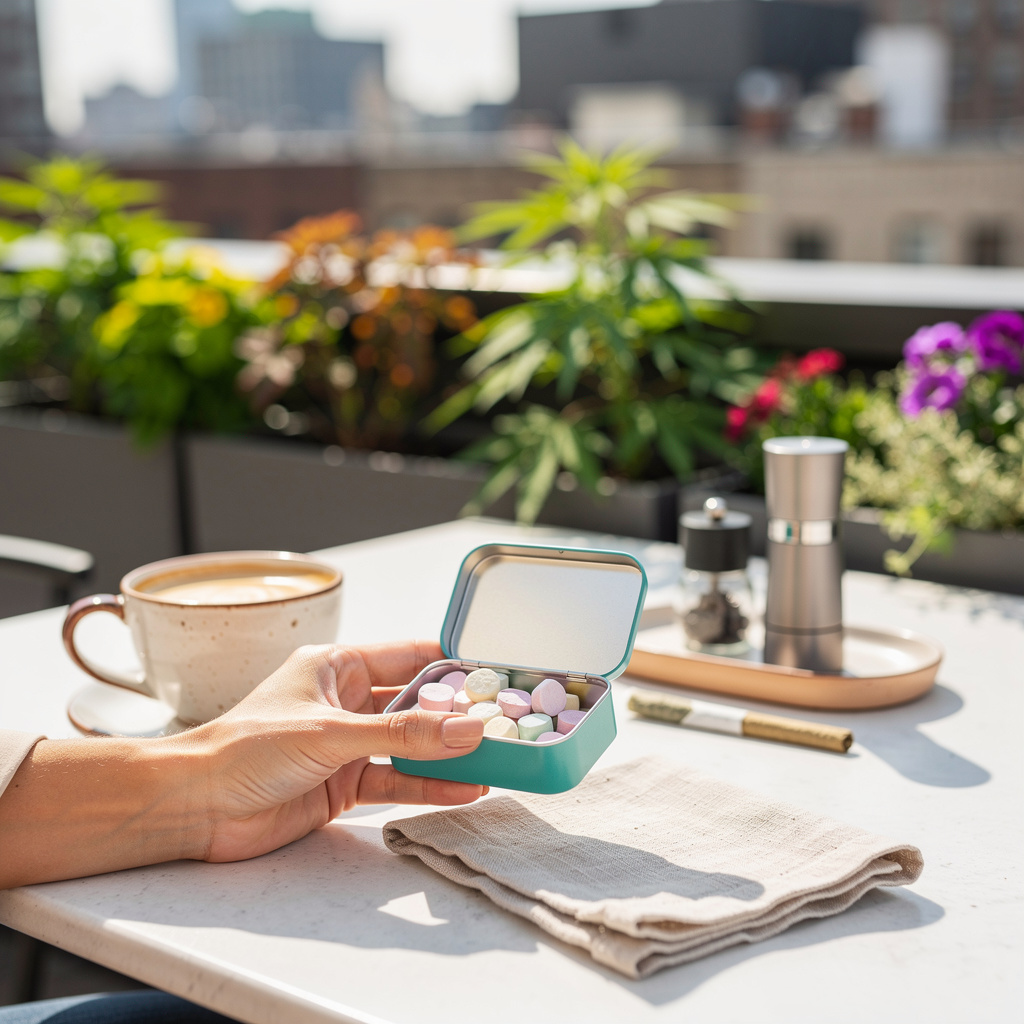

Microdosing Weed for Work: What NYC Professionals Are Buying
NYC professionals are microdosing weed with low-dose gummies (2.5-5mg THC), tinctures with measured droppers, and low-potency vape pens to manage stre…
04/30/2026|admin
Microdosing weed means taking 1-5mg THC per dose – enough to sharpen focus and unlock creative thinking without any impairment. Low-dose edibles, tinctures, and microdose vape pens make it easy to dial in the exact amount that keeps you productive while keeping the high out of the equation.
A microdose is generally defined as 1-5mg of THC – roughly one-tenth to one-quarter of a standard recreational dose. The goal isn’t to feel high. The goal is to feel slightly more present, slightly more creative, and slightly less friction between you and your work. Dr. Dustin Sulak, a cannabis researcher and clinician, describes the microdose threshold as “the minimum amount that produces a noticeable but sub-perceptual effect.”
According to a 2025 survey by Brightfield Group, 22% of weed consumers in the United States now identify as regular microdosers, up from 11% in 2022. Among professionals aged 25-44, that number jumps to 31%. New York specifically has seen microdose product sales grow 45% year-over-year, making it one of the fastest-growing segments in the state’s legal pot market.
The distinction between microdosing and getting high is dose-dependent, not strain-dependent. Even a potent sativa strain at 1-2mg THC will produce subtlety rather than intensity. The products designed for this purpose – available at dispensaries like The Flowery – are precisely dosed to give you control.
Key Takeaway: A weed microdose of 1-5mg THC targets the “below the high” zone where cognitive benefits like focus and creative flow appear without the impairment, paranoia, or couch-lock that higher doses produce.
Not every pot product lends itself to precision dosing. Here’s how the main formats compare for the productivity-focused microdser.
| Product Type | Dose Precision | Onset Time | Duration | Discretion Level | Best For |
|---|---|---|---|---|---|
| Low-dose gummies (2.5mg) | Excellent | 45-75 min | 4-6 hours | High | Morning focus blocks |
| Tinctures (sublingual) | Excellent | 15-30 min | 3-5 hours | High | Adjustable mid-day dosing |
| Microdose vape pens | Good | 2-5 min | 1-2 hours | Moderate | Quick creative sessions |
| Mints/lozenges (1-2mg) | Excellent | 20-40 min | 3-4 hours | Very high | Meetings, commutes |
| Infused beverages | Good | 15-30 min | 3-4 hours | High | Afternoon workflow |
Tinctures are the power tool for microdosing professionals. A standard dropper lets you measure down to 1mg increments, and sublingual absorption means you feel effects in 15-30 minutes rather than waiting an hour. Brands like Ayrloom specialize in precisely calibrated products that take the guesswork out of dosing.
Low-dose gummies at 2.5mg per piece are the most popular microdose format by sales volume, according to Headset Analytics. They’re consistent, portable, and look like any other supplement in your desk drawer. The Flowery carries multiple 2.5mg options designed specifically for the microdose use case.
Vaporizers offer speed but less precision. A single small puff from a vape pen delivers approximately 1-3mg THC, but the actual amount varies based on draw length, temperature, and individual tolerance. For professionals who need exact control, edibles and tinctures win.
The neuroscience is catching up to what microdosers have reported anecdotally for years. THC at low doses interacts with the endocannabinoid system’s CB1 receptors, which play a role in dopamine regulation, working memory, and divergent thinking – the cognitive process behind creative problem-solving.
A 2024 study from the University of Toronto published in Psychopharmacology found that participants given 2.5mg THC scored 18% higher on divergent thinking tasks compared to placebo, while those given 10mg scored 12% lower. The relationship between weed and creativity is biphasic – a little helps, a lot hurts.
Focus benefits appear through a different mechanism. Low-dose THC reduces background anxiety and mental chatter without suppressing executive function. A Consumer Reports survey found that 64% of weed microdosers reported improved ability to enter “flow states” during work, and 71% said they experienced fewer intrusive thoughts.
This tracks with what pot users in New York’s professional class have been discovering at The Flowery’s locations – particularly the East Village and Soho shops, which serve heavy concentrations of creative professionals and tech workers.
Consistency beats improvisation. The most effective microdosing schedules follow a pattern rather than random use. Here are three proven frameworks used by productivity-focused pot microdosers.
The “Workday Protocol” involves taking 2.5-5mg THC once in the morning, typically 30-60 minutes before your most demanding cognitive task. This is the most popular schedule, used by an estimated 45% of regular microdosers according to Brightfield Group data. It pairs well with tinctures or gummies.
The “Creative Sprints” method uses a microdose vape pen for 1-2 small draws only during designated creative work blocks – brainstorming sessions, writing, design work. Duration is shorter (1-2 hours per session), and the faster onset of inhalation matches the time-boxed nature of creative sprints. Roughly 28% of professional microdosers prefer this approach.
The “Fadiman Protocol,” adapted from psychedelic microdosing research by Dr. James Fadiman, involves dosing every third day. Day 1 is a microdose day, Day 2 is an observation day (no dose, but residual effects may linger), and Day 3 is a baseline day. This schedule helps prevent tolerance buildup, which is a real concern with daily weed use. According to Project CBD, tolerance to THC’s cognitive effects can begin developing within 7-10 days of daily use.
The right schedule depends on your work pattern. The Flowery’s budtenders hear these questions constantly and can match your professional rhythm to a product and schedule that makes sense.
Honesty matters here. Microdosing pot is not risk-free, and productivity professionals should understand the trade-offs.
Tolerance creep is the biggest practical risk. What starts as 2.5mg effective can drift to 5mg, then 7.5mg, at which point you’re no longer microdosing – you’re just dosing. A 2025 study in Drug and Alcohol Dependence found that 38% of daily microdosers increased their dose within six months. Building in tolerance breaks (2-3 days off per week) is the standard preventive measure.
Workplace drug testing remains a factor. Even at microdose levels, THC metabolites accumulate and will trigger a standard urine test. According to NORML, THC metabolites can be detectable for 3-30 days depending on frequency of use and body composition. New York law prohibits employers from testing for recreational weed in most cases, but federal employees and safety-sensitive positions are exempt.
Timing errors happen. Taking your weed edible too late in the morning can push peak effects into an afternoon meeting you’d rather be sharp for. Keeping a simple log of dose, time, and perceived effects for the first two weeks helps you calibrate precisely.
| Risk Factor | Likelihood | Mitigation |
|---|---|---|
| Tolerance creep | Moderate (38%) | 2-3 off days per week |
| Failed drug test | Low in NYC (state protections) | Know your employer’s policy |
| Overconsumption | Low with edibles/tinctures | Use pre-dosed products |
| Next-day fog | Very low at 1-5mg | Keep doses under 5mg |
| Dependency concerns | Low at microdose levels | Follow structured schedule |
Start with a visit to The Flowery and tell the budtender you’re interested in microdosing for productivity. That one sentence changes the entire conversation. They’ll steer you away from the 25mg gummies and toward the 2.5mg precision products that actually serve your goals.
Buy a tincture and a pack of low-dose gummies for your first week. Use the tincture on days when you want faster onset and precise control. Use the gummies on days when you want set-it-and-forget-it dosing. Track everything – dose, time, what you were working on, how you felt. By day seven, you’ll know your sweet spot.
The loyalty program makes the economics work for regular microdosers. Because you’re buying small amounts frequently rather than large amounts occasionally, points accumulate steadily. A single pack of 2.5mg pot gummies can last a microdosing professional two weeks or more, making this one of the most cost-effective ways to use weed.
No. Even at 1-2mg doses, regular THC use produces detectable metabolites in urine for 3-30 days depending on frequency and body fat percentage. New York state law protects most employees from weed testing, but federal positions and safety-sensitive roles remain exempt from these protections under current regulations.
At 1-5mg THC, most people do not feel traditionally high. The experience is more like a subtle shift in focus and reduced mental friction. If you feel impaired, your dose is too high. Drop by 1mg increments until you find the sub-perceptual sweet spot where benefits appear without any noticeable intoxication.
Edible microdoses last 4-6 hours. Tinctures taken sublingually last 3-5 hours. Vape microdoses are shortest at 1-2 hours. For a standard 8-hour workday, most professionals find that a single morning edible dose or two tincture doses spaced 4 hours apart provide consistent coverage.
Yes. New York legalized recreational pot for adults 21 and older in 2021, and there are no restrictions on dose size for personal use. Purchasing from a licensed dispensary like The Flowery ensures your products are lab-tested and accurately labeled, which is critical when precise dosing is the entire point.
Sativa and sativa-dominant hybrid strains are generally preferred for focus and creative microdosing. These strains contain higher concentrations of terpenes like limonene and pinene, which are associated with alertness and mental clarity. Indica strains tend toward relaxation, which can work against productivity goals.
Yes. Tolerance develops with regular THC use at any dose level, though more slowly at microdose amounts. Research suggests tolerance effects begin within 7-10 days of daily use. Building in 2-3 non-dose days per week significantly slows tolerance development and maintains the effectiveness of your pot microdosing routine.
Microdosing weed is not about getting high and hoping for the best. It’s a deliberate practice with specific products, precise doses, and structured schedules. Get it right, and the line between focused work and creative play gets beautifully blurry – in exactly the way you want it to.
NYC professionals are microdosing weed with low-dose gummies (2.5-5mg THC), tinctures with measured droppers, and low-potency vape pens to manage stre…
Store Atmosphere for Microdosing Productivity Professional You’re a professional who’s discovered that microdosing enhances focus, creativity, and pro…
Microdosing weed means taking sub-perceptual to mildly perceptual doses — typically 1 to 5mg THC at a time — to access subtle effects without the impa…